

For decades, waste has been treated as a logistical issue inside most organizations. Materials are discarded, collected, documented, and transported away from facilities as part of routine operational processes. As long as waste is removed efficiently and compliance requirements are met, the system appears to function without significant concern.
Yet beneath this routine lies a critical gap that few organizations fully recognize.
Most companies do not actually understand their waste.
They know the cost of disposal. They know how often containers are collected. They may even track recycling rates for sustainability reporting. But when deeper questions arise about the composition of waste streams, the origin of discarded materials within operations, or the potential value embedded in those resources, the answers often become uncertain.
This disconnect reveals what we call the waste data problem — a structural lack of visibility into the materials organizations discard every day.
As regulatory expectations increase and circular economy strategies become more central to business operations, this blind spot is becoming increasingly difficult to ignore.
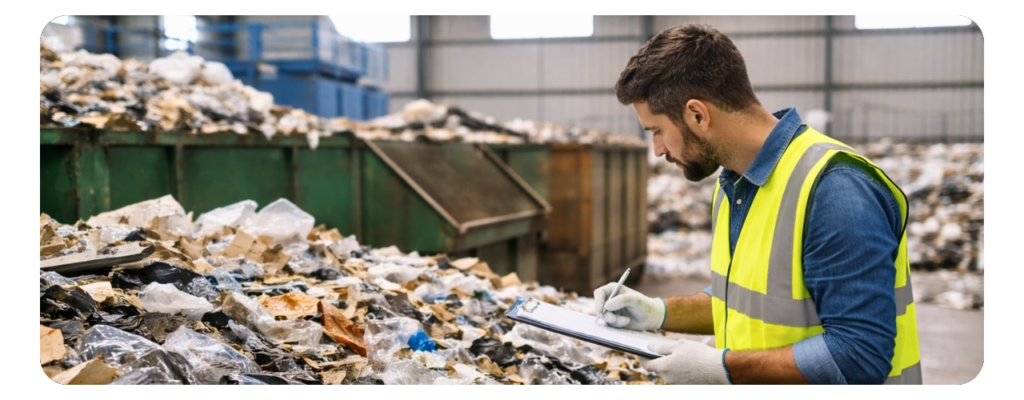
The Illusion of Waste Visibility
Many organizations believe they already have sufficient oversight over their waste streams. Disposal contractors provide reports detailing tonnage and material categories, environmental teams maintain compliance documentation, and sustainability reports include metrics related to recycling and landfill diversion.
These systems create a sense of control, yet they rarely provide the depth of information required to understand waste strategically.
Waste data is typically fragmented across operational departments. Compliance teams track regulatory classifications. Finance departments monitor disposal costs. Logistics teams manage storage and collection schedules. External contractors maintain transport and treatment records.
Each of these elements provides a piece of information, but rarely do they form a unified understanding of how waste is generated across the organization.
As a result, companies often believe they understand their waste while only seeing its final stage — disposal.
Everything that happens before that moment remains largely invisible.
Waste Is Not Just Material — It Is Information
Every discarded material reflects something about how an organization operates.
Waste streams can reveal inefficiencies in production systems, imbalances in procurement practices, or limitations in product design. Surplus materials may indicate over-purchasing or inaccurate forecasting. Residual inputs can signal inefficiencies in manufacturing processes. Even the type and composition of waste can provide insight into how effectively resources are being used.
In this sense, waste is not merely a byproduct of industrial activity.
It is a form of operational intelligence.
Yet when waste management is approached solely as a disposal function, this intelligence is lost. Materials leave the facility without analysis, and the valuable information embedded in those waste streams disappears with them.
Organizations invest heavily in analyzing production data, supply chain performance, and financial metrics. However, one of the most revealing datasets within their operations — waste — often remains unexplored.
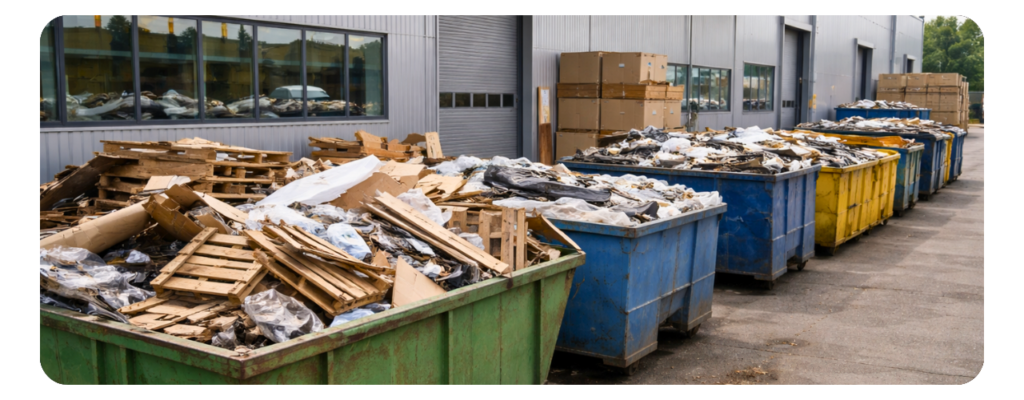
The Strategic Risks of Poor Waste Data
The absence of structured waste data can expose organizations to risks that extend far beyond operational inefficiency.
Regulatory frameworks around the world increasingly require companies to demonstrate detailed traceability of waste streams. Authorities expect accurate classification, documentation, and transparency regarding the final destination of discarded materials. When waste data is incomplete or fragmented, companies may face compliance vulnerabilities during audits or inspections.
Beyond regulatory exposure, poor waste visibility also masks financial inefficiencies. Materials that are purchased, transported, and partially used before being discarded represent a hidden form of operational leakage. Without understanding where these losses occur, organizations continue to absorb unnecessary costs embedded within their processes.
More importantly, the lack of waste intelligence prevents companies from identifying opportunities for improvement. Waste streams frequently contain recoverable materials, signals of process inefficiencies, and insights into supply chain optimization. Organizations that analyze these signals can uncover opportunities to redesign processes, recover resources, and strengthen operational resilience.
Those that ignore them remain blind to these possibilities.
The Emergence of Waste Intelligence
A growing number of forward-thinking organizations are beginning to approach waste from a different perspective.
Rather than seeing waste purely as a material that must be removed, they are beginning to treat it as a dataset that reveals how resources flow through their operations.
This shift has given rise to what can be described as waste intelligence.
Waste intelligence involves systematically mapping waste streams, analyzing their composition, and identifying the operational patterns they reveal. By examining waste through this analytical lens, organizations can uncover inefficiencies, compliance risks, and opportunities for resource recovery that were previously invisible.
In many cases, simply mapping waste flows across operational processes reveals insights that organizations had never considered before.
When waste is understood as data, it transforms from an operational burden into a strategic asset.

How Hyperion Global Supports Waste Intelligence
At Hyperion Global, we work with organizations seeking to move beyond traditional waste management and toward a more strategic understanding of their resource systems.
Our approach focuses on uncovering the intelligence hidden within waste streams.
Through detailed waste mapping and operational analysis, we help organizations identify where waste is generated, how it moves through operational systems, and what risks or opportunities are embedded within those flows. This process often reveals hidden inefficiencies, untracked materials, and potential resource recovery opportunities that had previously remained invisible.
By structuring waste data and integrating it into broader operational insights, companies gain a clearer understanding of how their resource systems function. This allows them to strengthen regulatory compliance, reduce operational inefficiencies, and explore circular economy strategies that transform discarded materials into productive assets.
Rather than treating waste as a cost of doing business, organizations can begin to view it as a source of strategic intelligence.
A New Question for Modern Organizations
The global conversation around sustainability is evolving rapidly. Companies are no longer evaluated solely on how they dispose of waste but increasingly on how efficiently they manage resources throughout their operational ecosystems.
In this context, waste data is becoming an increasingly important indicator of organizational maturity.
Organizations that understand their waste streams gain the ability to redesign processes, recover materials, and build more resilient resource systems. Those that continue to treat waste as a logistical afterthought risk overlooking one of the most revealing datasets within their operations.
Ultimately, the question is not simply about waste management. It is about understanding the flow of resources within complex organizational systems. And that raises a simple but powerful question.
Do you truly know what your organization is throwing away?
Because once that question is examined with the right level of insight, waste stops being a problem to remove. It becomes intelligence waiting to be uncovered.